
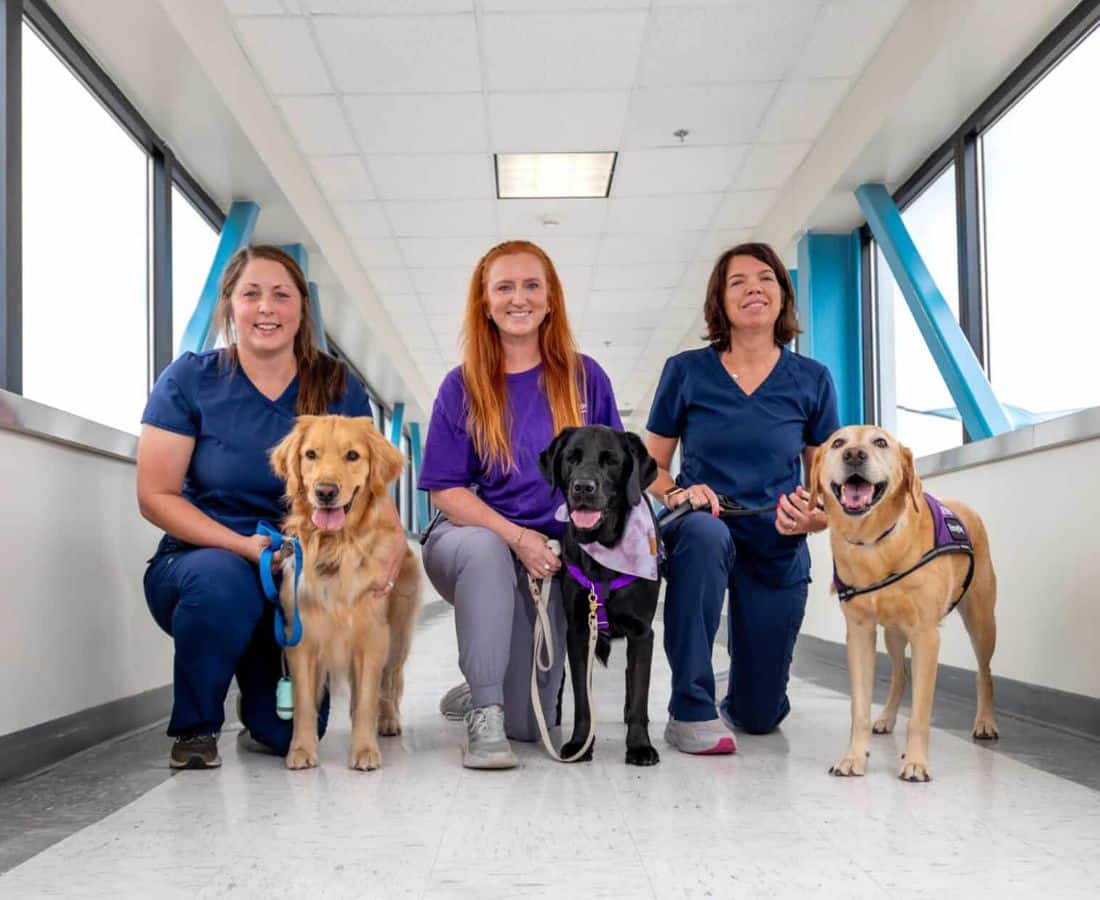
Across ECU Health Medical Center and the James and Connie Maynard Children’s Hospital, three dogs named Clive, Erving and Sam are leaving pawprints in the heart of patients, their families and team members alike. Whether in rehabilitation or pediatrics, these four-legged friends bring joy, motivation and emotional support to patients and their families.
Sam’s arrival was the result of nearly eight years of advocacy and planning by Child Life specialists Ashton Ayers and Chelse Smith, along with colleagues Jaymi Mendoza and Christy Denius. The ECU Health Foundation provided the funding to bring Sam on board. After years of research and collaboration with the ECU Health Foundation, funding was secured and Sam officially joined the team in November 2023. Sam was matched with handlers Ayers and Smith after they were vetted through the organization and the hospital.
Sam now supports pediatric patients, including those in the ICU, offering comfort during procedures, emotional support during difficult moments and motivation for children facing medical challenges.
Sam is the first full-time facility dog at ECU Health. Her care is fully-funded through donations to the Maynard Canine Crew program. With donor support, Sam helps our child life specialists address children’s unique needs, offering emotional support and joy during challenging medical journeys.
Support Maynard Canine Crew here.

The James and Connie Maynard Children’s Hospital at ECU Health Medical Center was filled with smiles and excitement as CAPTRUST employees, in partnership with the ECU Health Foundation, arrived with bright green boxes packed with fun. These Cheeriodicals care packages were filled with age-appropriate toys, crafts and comfort items, and were hand-delivered to pediatric patients and their families to brighten their hospital stay.
The impact of the delivery extended far beyond the contents of each box. For the CAPTRUST and Cheeriodicals teams, it was an affirmation of the difference collaboration and giving back can make.
“The delivery was more than just a gift,” said Scott Senatore, chief philanthropy officer, ECU Health Foundation. “It was a moment of true joy for children and families navigating some of the hardest moments of their lives, and for two ECU alumni, it was a chance to give back to the community that helped shape them. ECU Health is so grateful to CAPTRUST and Cheeriodicals for their compassion and care for the patients and families we serve.”
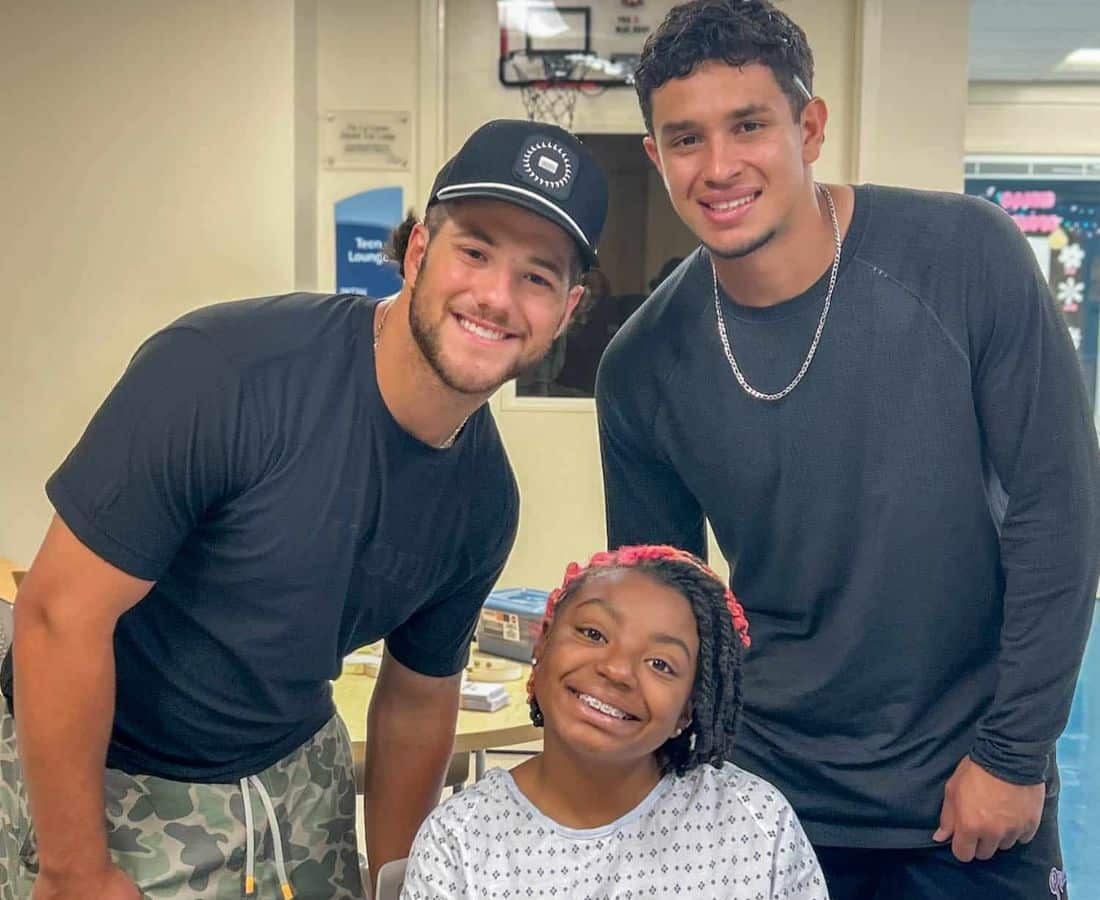
East Carolina University (ECU) Baseball player Parker Byrd has stepped up to the plate to lead Homers That Help, a charity initiative supporting families at the James and Connie Maynard Children’s Hospital at ECU Health Medical Center. Taking over from former player Carter Cunningham, Byrd has embraced the opportunity to expand the program’s impact and continue its mission of giving back.
Managed by ECU Health Foundation, the funds raised through Homers That Help have had a direct impact on families, covering essential costs like gas and food gift cards to ease their hospital stays. Funds also will be going to other needs of Maynard Children’s Hospital to improve care and the hospital experience for pediatric patients and their families.
To date, Homers That Help has raised over $75,000. To learn more about Homers That Help or to give, please visit give.ecuhealthfoundation.org

East Carolina University (ECU) Baseball player Parker Byrd has stepped up to the plate to lead Homers That Help, a charity initiative supporting families at the James and Connie Maynard Children’s Hospital at ECU Health Medical Center. Taking over from former player Carter Cunningham, Byrd has embraced the opportunity to expand the program’s impact and continue its mission of giving back.
The idea for Homers That Help was born after Cunningham participated in a career shadowing experience at ECU Health Medical Center in November 2023. Walking through Maynard Children’s Hospital, he felt a deep calling to do something meaningful for the young patients and their families.
Managed by ECU Health Foundation, the funds raised through Homers That Help have had a direct impact on families, covering essential costs like gas and food gift cards to ease their hospital stays. Funds also will be going to other needs of Maynard Children’s Hospital to improve care and the hospital experience for pediatric patients and their families.
To date, Homers That Help has raised over $75,000. To learn more about Homers That Help or to give, please visit give.ecuhealthfoundation.org
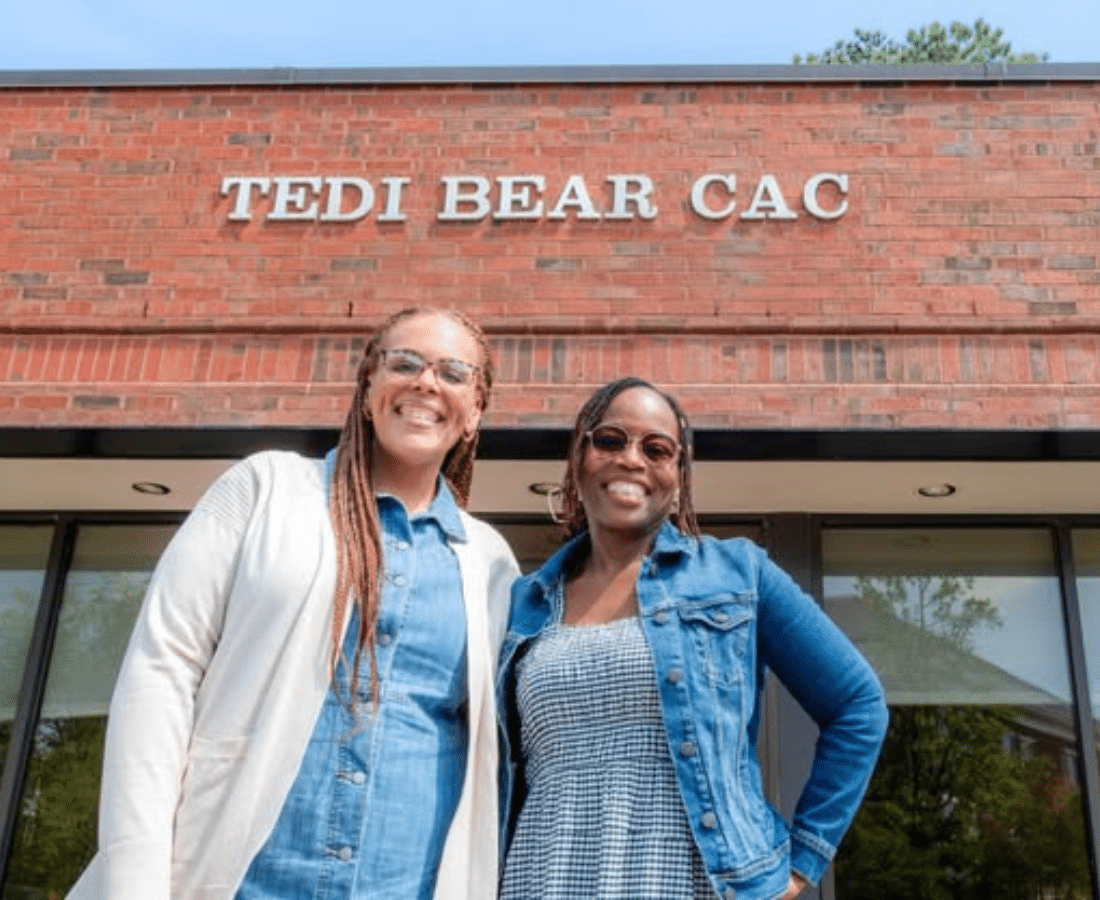
Blue and silver Pinwheels for Prevention adorned yards, clinics, daycares and other businesses in Greenville, eastern North Carolina and across the country throughout National Child Abuse Prevention Month in April. The pinwheels, meant to represent childlike whimsy and lightheartedness, are a signature display during the month-long campaign to raise awareness around a difficult and important topic.
For team members and supporters at ECU Health and the Brody School of Medicine at East Carolina University’s Tender Evaluation, Diagnosis and Intervention for a Better Abuse Response (TEDI BEAR) and Mt. Olive Children’s Advocacy Centers (CACs), the tireless effort to prevent child abuse in eastern North Carolina is a year-round endeavor.
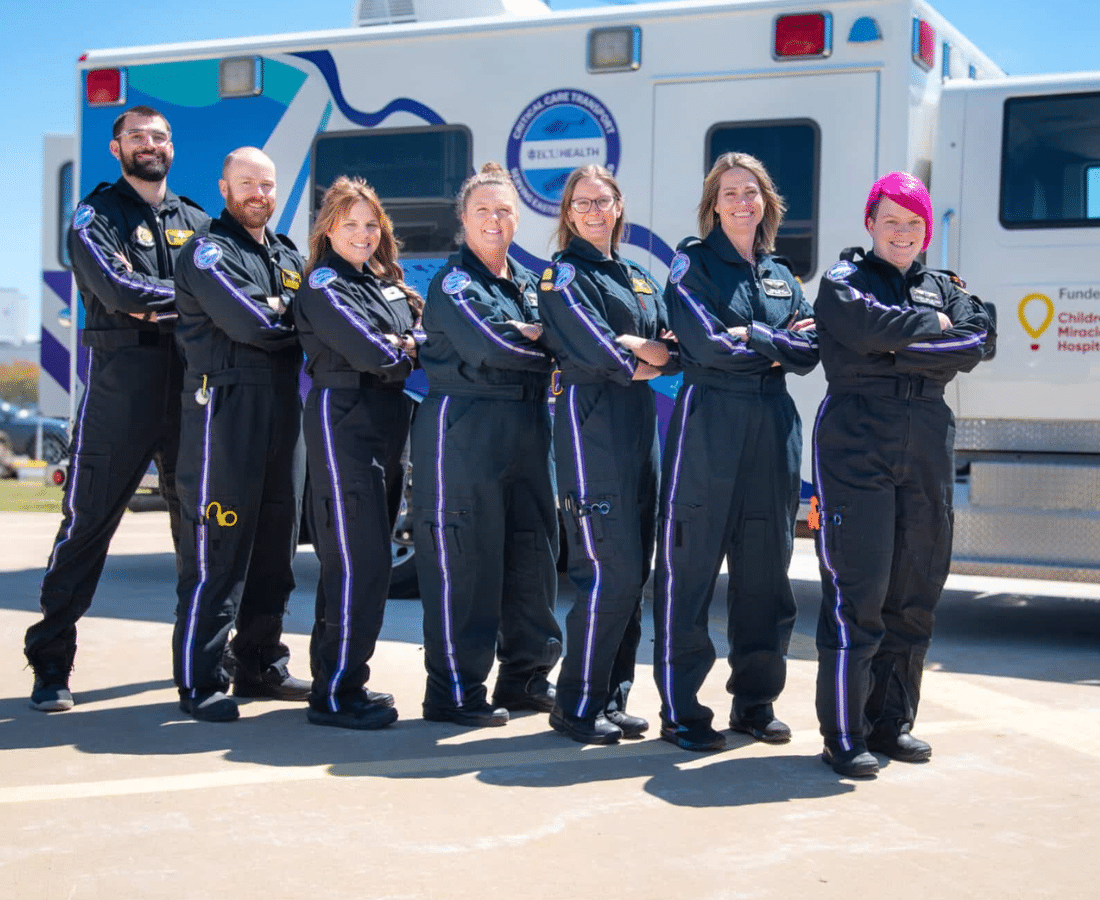
On Wednesday, April 16, ECU Health’s EastCare celebrated a remarkable milestone: 40 years of dedicated service to the communities of eastern North Carolina. Founded in 1985, the program has grown from a single helicopter operation to a comprehensive medical transport service, offering both ground and air transportation.
EastCare transports patients directly from the scene of an emergency or transfers them from regional hospitals to ECU Health Medical Center, ensuring that critically ill and injured patients receive timely and advanced medical care.
Today, the program operates seven aircraft, with five in use and two back-ups. With eight bases within the region — both ground and air — and 28 ambulances, coverage has expanded to include all of eastern North Carolina as well as parts of South Carolina and Virginia.
You can support the vital services EastCare provides by giving here.
The ECU Health Foundation recently recognized four team members at ECU Health Medical Center with 2024 Brody Awards, on behalf of the Brody families of Kinston and Greenville.
The Brody Awards, established in 1988, are given to team members who demonstrate unparalleled care, compassion, professionalism and commitment in all they do. The awards honor a registered nurse, an allied health professional, a clinical support team member and an Intensive Care Unit nurse.
The 2024 honorees are: Pam Hall, triage telephone nurse in Medical Oncology; Melinda Edwards, trauma registry supervisor; Kaitlin Lehrke, staff nurse II on the Surgical Intensive Care Unit; and Stacey Greenway, former director of Cardiovascular Disease Management.

Access East is a 501(c)(3) that strives to improve health access to, and coordination of, quality care in eastern North Carolina. Access East serves as an important part of the ECU Health system of care, offering support for under- and uninsured individuals and helping navigate the health care system through service lines such as Access East Care Management, HealthAssist, ACA Navigators and Health Opportunities Pilot.
Out in the field
One such facet of their service comes through the Farmworker Program, which works not only to help enroll members of the ENC H-2A (temporary visa) farmworker community in low-cost insurance, but also to direct them to available community health care options, and to provide emergency medical training like wound care or cardiopulmonary resuscitation (CPR). In just under two months, the program has reached more than 2,000 farm workers.
Juan Allen, a community coordinator and Affordable Care Act (ACA) navigator for the program, plays a key role in helping the farmworker community receive the services and care it needs. “I’ve been with Access East for seven or eight years,” Juan said. “I was born and raised in El Salvador on a farm, which is what got me interested in doing this work.” The goal of the program, he said, is to help members of the migrant farming community prevent injuries and illness. “Last year we lost four farm workers to heat stroke, and someone else passed away because no one in the field knew CPR,” he explained.
“So, we go out to the farms and do CPR training, heat exhaustion and heat stroke education, Stop the Bleed training, education about tobacco sickness and anything else they need.” Juan said there is also skin cancer education and screenings, dental cleanings, mental health support and vaccines. “During COVID, we were coordinating vaccines, so that with providers’ help, we got 80-100 people vaccinated per day.”
Juan has also trained as an instructor for the Mental Health First Aid (MHFA) trainings, which is an evidence-based, early-intervention course that, virtually or in-person, uses community-specific scenarios, activities and videos to teach people the skills they need to recognize and respond to mental health and substance use challenges. The ECU Health Foundation awarded funding to Safe Communities Coalition, a non-profit that works alongside the Eastern Carolina Injury Prevention Program (ECIPP) to prevent injuries. “Juan has reached a population (farmworkers) that we have struggled to reach, yet we knew desperately needed the education,” said Sue Anne Pilgreen, the executive director for the Safe Communities Coalition, the manager of the ECIPP and the manager of the Pediatric Asthma Program. “This past fiscal year, we have trained a total of 196 people in MFHA, and 92% felt like they could recognize someone who was suicidal after completing the class.”
“Juan is one of the hardest workers I know,” said Shantell Cheek, the director of Access East. “He has a passion to really help those who are underserved, and he is a true link between Access East, ECU Health and the Farmworker Program.” Wherever there is a need, she said, Access East and the Farmworker Program is there.
The program, which initially was established to help H-2A workers get visas and enroll in the ACA, has grown significantly. “We still do the ACA enrollment,” Cheek said. “But Juan provides care coordination, and different entities like the North Carolina Department of Health and Human Services and the North Carolina Growers Association partner with us. We now help these individuals get medications they need, assist them when they go to the hospital and are being discharged, set up with primary care providers and provide the education like CPR and skin cancer. And it’s not just the migrant workers; it’s their families too. Wherever there is a need, anywhere across the state, they call Juan.”
Partnering with the Brody School of Medicine
She emphasized that Juan tirelessly creates partnerships with regional and community organizations. Shantell also highlighted Access East’s, and Juan’s, ongoing collaboration with East Carolina University’s Brody School of Medicine. “During their first or second year of medical school, students can select a project to work on and Juan’s name often comes up when they mention an interest in the communities we serve.”
Deanna Torres, a second-year medical school student at the Brody School of Medicine, worked with Juan this past summer as a part of a project required of the school’s four Distinction tracks. Deanna opted to apply for the Service-learning track, which is what led her to Access East. The other tracks include Health System Transformation and Leadership, Medical Education and Teaching and Research.
Deanna said she has always had a passion for grassroots community service. “I’m undecided on my specialty right now, but I know I want to help underserved, minority populations.” Deanna grew up participating in a variety of community service activities, including a medical mission to Honduras and a Benedictine Volunteer Corps trip to the Rosebud Indian Reservation in Mission, South Dakota. Once she entered medical school, Deanna continued her journey in service by joining the Service-learning track. “It isn’t required to join a track,” Deanna explained. “But when I was applying to medical schools, the Service-learning track was a major factor in deciding to come here.”
Students in the Service-learning track work extensively with medically-underserved, marginalized and rural populations during their medical school career. They attend a lecture series specific to that track, but they are also required to participate in a service-learning internship during the summer after their first year of medical school. “We select an organization to partner with, and then we create a longitudinal service-learning project aligned with that organization,” Deanna said. While the internship only lasts a summer, the students’ work on their projects continues until they graduate.
Making a difference
With Juan as her mentor, Deanna said she gained an insider’s perspective on a migrant farmworker’s daily life. “I saw how migrant farmworkers are processed after entering the country. I saw how farms are laid out, and I got to see their living conditions, which aren’t always great. I’ve lived in North Carolina my whole life, and I didn’t know how many farmworkers we have in this region or what their needs were.” This exposure led Deanna to her project’s focus, which is “Increasing Mental Health Services to Hispanic Migrant Farmworkers in Pitt County.” The migrant workers, she discovered, often struggle with mental health issues, like depression. “They leave their home country and their families, work in the heat and have no car or independence, and that can be challenging. I want to advocate for the lack of awareness and communication about mental health in the Hispanic community,” Deanna said.
Juan has been instrumental in helping Deanna make the connections and partnerships necessary to work on her project. “He’s a popular man,” she laughed. “Any time I mention Access East, everyone knows him.” Deanna said she appreciated Juan being willing to mentor her, despite his busy schedule. “As a medical student, it can feel daunting to reach out because everyone is busy, but he was always available and offered me resources, took me to the farms and provided logistics. He knows all about these things.”
Dr. Jennifer Crotty, a pediatrician and an associate professor in the Department of Pediatrics at the Brody School of Medicine, as well as the director of the Service-learning distinction track, facilitates connections between students in the Service-learning track and community partners. “The track primarily focuses on local impact and grassroots efforts,” Dr. Crotty said. Of how she came to direct this specific track, she cited her background in pediatrics. “I realized that to have healthy children, we need healthy families and communities,” she said. “That’s why we want to do this advocacy work.” Access East has been a significant partner in this work. “Access East addresses the things we know need to be addressed. When students work with them, they see the time and energy and resources it takes to do medicine in these rural communities.” While she has never met Juan personally, she knows her students get a great experience when they work with him. “He always finds a place for our students, and the students always say their experience was amazing.”
This work is valuable, Deanna said, because it puts a face and name to abstract medical concepts students learn in school. “It puts a story to what you’re learning,” she said. “It shows us that a patient isn’t just one disease, but they are dimensional, and it helps us be better physicians who treat in a holistic manner. This community needs us to advocate for them.” Dr. Crotty agreed, saying that having students participate in these service learning partnerships through ECU Health make them better physicians, no matter what specialty they choose. “They take the knowledge they gained through service learning to wherever they’re going. I love that someone in their surgery residency is thinking about whether their patient has enough food at home. We graduate good doctors because our students are exposed to these types of things, and they know how to handle it.” Juan said that ultimately, this work gives migrant farmworkers a voice. “They’re only here for eight months and they don’t know their rights,” he said. “Access East is vital to reach out to farm workers so we can be a go-between them and the health system.”

It’s not just in October, which serves as Breast Cancer Awareness Month, that you can find the ECU Health Cancer Care Outreach team making connections in the community.
Jennifer Lewis, outreach coordinator for cancer care at ECU Health Medical Center, said she spends much of her time reaching out to community partners, talking to groups in Pitt County and beyond, and connecting with ECU Health patients and families. However, she said, the most rewarding part of her job is the monthly free breast clinic she helps run.
The clinic, for women in Pitt County age 40 and older who are low income and do not have health insurance, provides screening mammograms while sharing other resources available for health care in the area with those participating in the screening.
Lewis said she is grateful to help with the program and is proud of the impact it has on Pitt County.
“Patients don’t see a bill because of donations to the Cancer Center and the ECU Health Foundation, and that’s just an amazing thing we get to offer,” Lewis said. “We start with a breast exam by a provider to check for obvious abnormalities. Then they have their 3D mammogram, so they get state of the art imaging just like anyone else would get and they don’t get lesser quality. If they have an area that is of suspicion, we can do a diagnostic mammogram and if the radiologist looks at those images and feels like there’s some more concern about something, next would be an ultrasound of that area of suspicion. The program that we have here pays for all that.”
She shared that while ECU Health Beaufort Hospital and Outer Banks Health currently have their own programs outside of Greenville and Pitt County, other hospitals across ECU Health’s system are working toward establishing the program as well.
Lewis said the partnerships and volunteerism associated with the program make it truly special. She and her team work closely with the Pitt County Health Department to help patients who need further care through the Breast and Cervical Cancer Control Program (BCCCP).
“We can’t do this without our partners, that’s for sure,” Lewis said. “We have such a great working relationship with the Pitt County Health Department and the mammography technicians, Patient Access Services, Language Access, Volunteer Services, radiology and ultrasound, and then our nurse residents who help out all work together so well. After patients are seen during the free clinic day, we have Access East on hand, too, to share information and resources about other services they can get access to. It’s such great teamwork all around that makes these events successful.”
The program sees so many patients throughout the year that they’ve recently added an extra clinic day twice a year, once in February and once in October, to help meet the needs of the community.
While Lewis is frequently in the community talking to groups and spreading awareness, October is especially important. She said she’ll spend much of the month meeting with community groups and in churches discussing risk factors, signs and symptoms and why screenings are important.
“This month is an intentional time set aside to speak about risk factors, family history, and signs and symptoms, because that’s the one time of the year that you can sit back and think, ‘OK, am I having any of these symptoms?’ Or ‘What is my family history? Because last year I didn’t have any, but this year my mother or sister has been diagnosed with it.’ It really creates that intention for people to have that moment sometime during the month,” Lewis said. “Whether it’s an ad on Facebook or hearing someone like me speak, it’s important to have that moment of reflection, remind yourself to get a mammogram and just put that in the forefront of women’s minds.”
She said if there’s one thing she could remind the community, it’s that anyone can be diagnosed with breast cancer. She noted that there are many myths, including that because someone is without family history, is otherwise healthy or is a male, that they cannot develop breast cancer. This is why she said it’s critical for everyone to be aware of signs and symptoms and receive screenings as recommended.
Resources
Breast Screening Events
ECU Health Cancer Care
More Breast Cancer Information
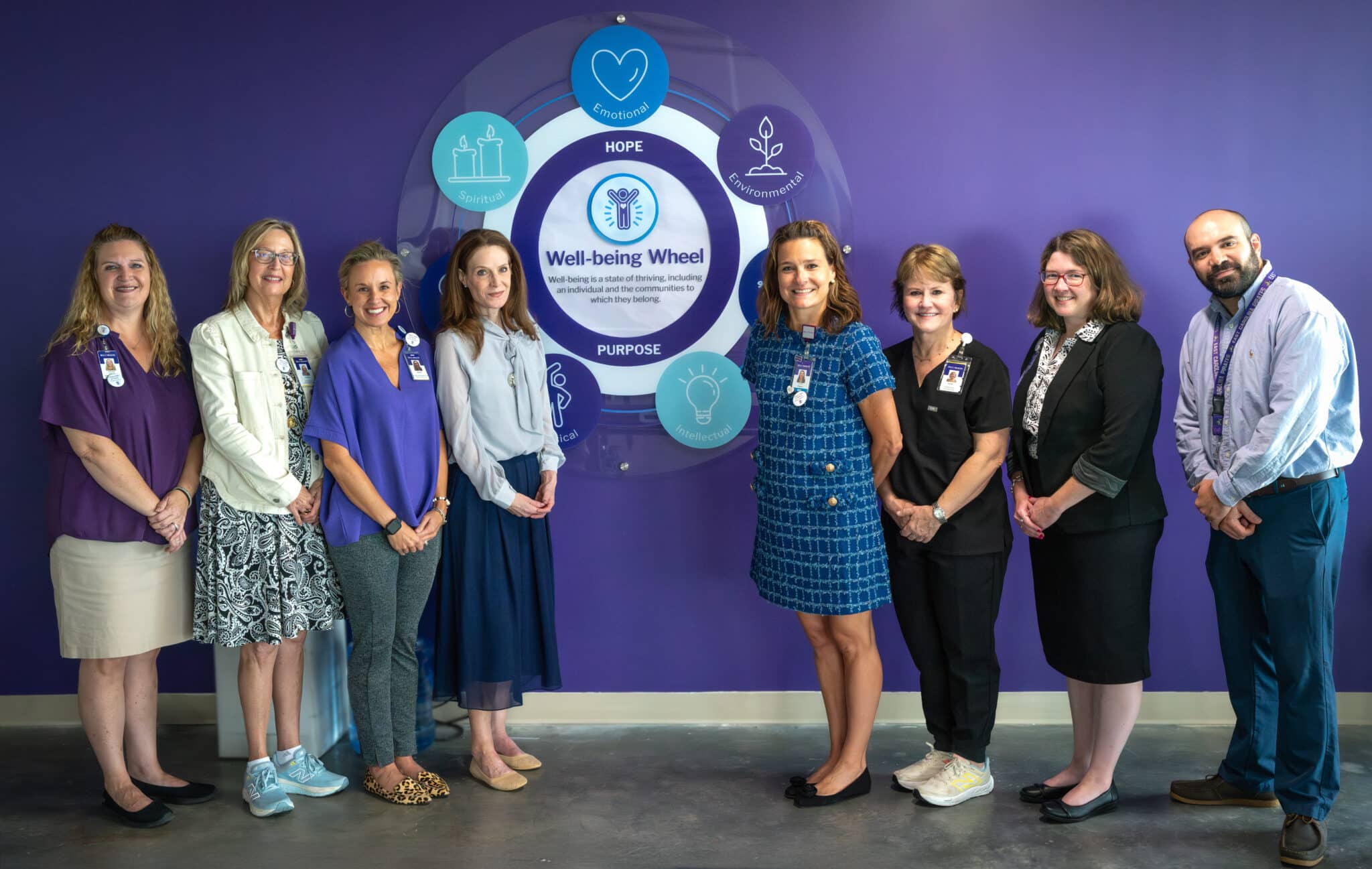
Healthy snacks, well-being resources, a mindful walking trail and more were all on display at ECU Health Medical Center’s new Resident Well-Being Zone as part of a recent pop-up event hosted by ECU Health’s Well-Being team.
Resident physicians from across the Medical Center were invited to the pop-up event as a way of showcasing the new space, intentionally designed to support their well-being as they continue in their journey in medical education.
The pop-up event, according to Dr. Christina Bowen, ECU Health’s chief well-being officer, is an important way of ensuring residents are aware of the resources available to them at ECU Health.
“We are thrilled to have a resident well-being zone and to be able to offer something unique and purposeful to our resident physicians, who play such an important role here at ECU Health Medical Center,” said Dr. Christina Bowen, Chief Well-being officer at ECU Health. “The pop-up events are a fun way to get our resident physicians engaged in well-being and mindfulness which we know will benefit them during their time here at ECU Health. Our team is excited to be able to host well-being events throughout the year.”
Located on the sixth floor of the Eddie and Jo Allison Smith Cancer Center at ECU Health Medical Center, the Resident Well-Being Zone officially opened in August after years of thoughtful design and funding provided by the ECU Health Foundation. The space is filled with all the essentials a resident may need: exercise equipment, charting space, healthy snacks, coffee, even a ping-pong table and more.
Dr. Cole Carter, a fourth-year physical medicine and rehabilitation resident, said the pop-up event and the space itself have proven to be a welcome asset in the resident experience at ECU Health.
“I think it’s great,” Dr. Carter said, noting that his favorite part of the space is the ping-pong table. “It’s a great place to check out when you need a break from the busy schedule. You can get a great view of Greenville and just take time to relax. I try to come up here once a month or so. This is a great asset for our residents and for those who may be looking for a residency program.”
Dr. Mary Catherine Turner, interim associate dean of Graduate Medical Education, understands first-hand the value of a Resident Well-Being Zone. She said she was fortunate to have one during her time as a resident physician, and it helped her take a break, refresh her mind and get re-engaged in the mission-driven work of providing high-quality health care. Now, she is excited that current and future resident physicians get to experience a similar benefit as they care for patients and continue to learn at one of the busiest academic medical centers in the nation.
“A space like this is important for residents,” Dr. Turner said. “Residents need a place where they can go and disconnect from their work for a little bit and reconnect with themselves. And importantly this is a place where residents can congregate together. I think there’s a lot that can be said for building a community, and this allows them the space to do that.”