

The Brody School of Medicine at East Carolina University held its 10th annual Medical Education Day April 25, celebrating scholarship and innovation in medical education.
The event included podium and poster presentations and the popular “Shark Tank” program, during which student presenters have five minutes to pitch their in-progress research to an expert panel and receive feedback on how best to move their projects forward.
Medical Education Day is traditionally a gathering of leaders, educators, students and other scholars that aims to provide a forum for sharing educational innovations in curriculum and teaching, enhances understanding of new approaches in medical education and strengthening the network of Brody community members interested in promoting educational excellence.
“Today marks another significant milestone in our ongoing commitment to advancing medical education and enhancing the quality of health care delivery in eastern North Carolina and beyond,” said Dr. Lisa Domico, teaching assistant professor in Brody toxicology, during opening remarks. “Today we will not only recognize the achievements of our educators, researchers and learners but also remember our dedication to the Brody mission. Our mission drives innovation, excellence and continuous improvement in medical education.”
The keynote speaker was Dr. Andrew Southerland, the Harrison Distinguished Teaching Professor of Neurology and executive vice chair of the Department of Neurology at the University of Virginia Health/UVA Stroke Center. Southerland is a 2006 Brody graduate and was a Brody Scholar. He is the past recipient of an early career award from the American Heart Association/American Stroke Association (AHA/ASA) National Clinical Research Program and has served as principal investigator for numerous clinical studies in the field of stroke and cerebrovascular disease.
Southerland’s address was titled, “Teaching Clinical Diagnostic Reasoning in the Age of AI – Domo Arigato, Mr. Roboto.”
Southerland discussed how artificial intelligence (AI) — which he also called “augmented intelligence” — can improve health care while the importance of a doctor-patient relationship remains at the forefront. He detailed some commercial AI products that contribute to medical care and how they can improve patient and provider experiences.
“I became interested in how we as educators need to consider artificial intelligence when it comes to medical education for the next generation,” Southerland said.
Southerland noted specific examples of products and programs in AI can help physicians better care for their patients. Providers can use AI and build upon its benefits using critical thinking and existing expertise.
“This is what we as humans can do well and how we can think about AI as a way to oversee what it’s doing,” he said.
Students earned accolades for their work during the event. Second-year medical students Jacob Richardson and Alissa Davis won the Shark with the Biggest Bite award for their presentation “Utilization of Artificial Intelligence Image Generation Tools to Augment Mnemonics for Medical Students: Proof of Concept.”
Alexandra Doherty, fourth-year medical student, won the Outstanding Podium Presentation award for her presentation, “A Delphi Consensus Study for the Development of a Specialty-Focused Ultrasound Curriculum for Fourth-Year Medical Students.”
The first-place poster award went to K. Ryan Dickerson, fourth-year medical student and Medical Education and Teaching Scholar, for his project “Near-Peer Created Full Length Practice Laboratory Practicals in Gross Anatomy and Embryology: An Effective Method of Learning in the Anatomical Sciences.”
The second-place poster award went Arden Vessie, fourth-year medical student for her project “Peer-Led Medical Spanish Education: Effects on Interprofessional Student Functional Language Self-Efficacy.”
The third-place poster award went to Michael Kovasala, first-year medical student and Taylor A. Creech, first-year medical student, for their project “Interprofessional Near-Peer-Created Resources in Gross Anatomy: Medical Student Support and Perceived Impact on Emotional Well-Being.”
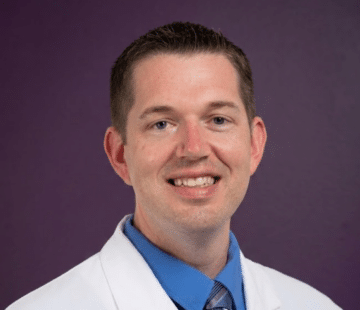

Dr. Michael Granet has provided more than patient care and dental instruction as an adjunct assistant professor at the East Carolina University School of Dental Medicine’s community service learning center (CSLC) in Brunswick County.
Through gifts totaling more than $100,000, Granet has invested in and helped the school obtain state-of-the-art equipment for the CSLC. Granet, the staff and dental students at the CSLC now have access to a cone beam computed tomography (CBCT)/panoramic X-ray unit, which provides 3D imaging; a TRIOS intraoral scanner and CoDiagnostix software; and a 3D printer. The cutting-edge equipment allows the care team to provide scans for dental imaging instead of having to take impressions.
“Technology is at the forefront of dental education now more than ever before, and Dr. Granet’s gift of this state-of-the-art equipment provides our students and residents with vital exposure to digital dentistry,” said Dr. Greg Chadwick, dean of the dental school. “This gift, coming from a part-time faculty member, leverages our ability to expand the scope of care for the communities we serve.”
Dr. Dianne Caprio, clinical assistant professor at ECU and director of dentistry at the Brunswick CSLC, said dentists can create a virtual model of patient’s teeth or print the model if needed. “Dentistry has gone digital, and we are just scratching the surface of all the possibilities,” Caprio said. “Having this equipment offers the students and residents an introduction to the digital dental world.”
Caprio said the new equipment allows staff the ability to design crowns, dentures and other prosthetics on the software and print them in the office. “We can plan for accurate placement of implants using the CBCT, TRIOS and the CoDiagnostix software by designing surgical guides and printing them in house,” she said.
Granet learned about the CSLC after moving to Wilmington from Maryland. He works at the center each Tuesday caring for patients’ periodontic and implant needs and serving as an instructor for the dental residents working there. “I made donations to the clinic so this equipment could be here and we could all use it and patients could benefit from it,” Granet said. “All I did was give the money. What I get back is much greater than the money I give. I am in a happy place when I get here (Brunswick CSLC) on Tuesday.”
Staff at the CSLC honored Granet for his support with a plaque at the center. Caprio said the upgrade in technology is important to the CSLC, but Granet’s “greatest gift is his time and dedication to teaching the residents and students.”

Dr. Michael Granet has provided more than patient care and dental instruction as an adjunct assistant professor at the East Carolina University School of Dental Medicine’s community service learning center (CSLC) in Brunswick County.
Through gifts totaling more than $100,000, Granet has invested in and helped the school obtain state-of-the-art equipment for the CSLC. Granet, the staff and dental students at the CSLC now have access to a cone beam computed tomography (CBCT)/panoramic X-ray unit, which provides 3D imaging; a TRIOS intraoral scanner and CoDiagnostix software; and a 3D printer. The cutting-edge equipment allows the care team to provide scans for dental imaging instead of having to take impressions.
“Technology is at the forefront of dental education now more than ever before, and Dr. Granet’s gift of this state-of-the-art equipment provides our students and residents with vital exposure to digital dentistry,” said Dr. Greg Chadwick, dean of the dental school. “This gift, coming from a part-time faculty member, leverages our ability to expand the scope of care for the communities we serve.”
Dr. Dianne Caprio, clinical assistant professor at ECU and director of dentistry at the Brunswick CSLC, said dentists can create a virtual model of patient’s teeth or print the model if needed.
“Dentistry has gone digital, and we are just scratching the surface of all the possibilities,” Caprio said. “Having this equipment offers the students and residents an introduction to the digital dental world.”
Caprio said the new equipment allows staff the ability to design crowns, dentures and other prosthetics on the software and print them in the office. “We can plan for accurate placement of implants using the CBCT, TRIOS and the CoDiagnostix software by designing surgical guides and printing them in house,” she said.
Granet learned about the CSLC after moving to Wilmington from Maryland. He works at the center each Tuesday caring for patients’ periodontic and implant needs and serving as an instructor for the dental residents working there.
“I made donations to the clinic so this equipment could be here and we could all use it and patients could benefit from it,” Granet said. “All I did was give the money. What I get back is much greater than the money I give. I am in a happy place when I get here (Brunswick CSLC) on Tuesday.”
Staff at the CSLC honored Granet for his support with a plaque at the center. Caprio said the upgrade in technology is important to the CSLC, but Granet’s “greatest gift is his time and dedication to teaching the residents and students.”

Future caregivers will be able to continue their education all thanks to a generous fund.
East Carolina University’s College of Nursing has been given a $1 million gift from the Service League of Greenville, giving scholars full tuition and fees for the academic year when they receive it.
The university says the major gift is one of the first made through the ECU Health Foundation, the philanthropic arm supporting ECU Health and the ECU health sciences campus.
“It is fitting for the Service League endowment to be one of the first major gifts established through the ECU Health Foundation as it highlights the alignment of the health system and the university and our shared mission to benefit the well-being of eastern North Carolina,” said Scott Senatore, chief philanthropy officer of the foundation. “The Service League is an outstanding community partner and a prime example of the relational bonds that connect ECU Health and the university. Their gift will further student success in the College of Nursing and outstanding patient care at ECU Health.”
Jeanne Martin, the nursing department’s interim chair, said the scholarships remove barriers for students who are putting themselves through school.
“This scholarship will pay dividends for a long, long time,” Martin said. “The need is real, and this is going to make a big difference.”
To qualify for this scholarship, students must be state residents and demonstrate are in need financially, have a 3.0 GPA or higher, and are committed to serving their community.

While the East Carolina University (ECU) baseball team is rounding into form as postseason play nears, they’re also taking time out to make a special difference in their community.
After a visit to ECU Health Medical Center last November, as part of a career shadowing opportunity, senior first baseman Carter Cunningham felt compelled to do something to help patients and families.
“I’d been praying for ways to give back to the community,” Cunningham said. “As we’re doing a tour of the entire campus, we walked into the [Maynard] Children’s Hospital and it was like God had smacked me in the face. It was like, this is what I have to do. I didn’t know what it would look like yet, though.”
He said that week, he went back to the team and asked for a small donation from everyone to spread some holiday cheer to patients and families at the children’s hospital. The response was more than he expected.
“We got about $500 and we were able to drop off some presents to the children’s hospital right before break,” he said. “It was awesome. We had about 20 players come in and we hung out in the playroom and had a great time.”
Tara Tadlock, a child life specialist at Maynard Children’s Hospital, said patients and families would subsequently talk about the visit for the next month. The same held true for Cunningham and his teammates, who also went on talking about how special the visit felt.
He said over the Christmas break he took more time to think about what he could do to make an impact for patients and families like those he’d met a few weeks before. Then the idea to start a foundation, Homers That Help, came to him.
It started with a call for donations on social media, one sponsor for each of ECU’s 33 home baseball games in 2024. The sponsor makes an up-front donation to the fund and an additional donation for each home run hit during the game. While he expected to need some time and make some calls to fill every game, the fund was complete after about 15 hours.
“The community here, I can’t describe it,” Cunningham said. “I get goosebumps talking about it because they’re so generous and so supportive, not only of ECU athletics, but the whole community. It was a testament to all the people that are here and I’m thankful and blessed to have an opportunity to be here.”
Because of the outpouring of support, Cunningham opened a “Fund B” for those who were not able to directly sponsor a game but still wanted make a donation. Cunningham is making donations himself as well, contributing $25 to the fund for each of his own home runs. With nine home runs, Cunningham is tied for the team lead and backing up his own efforts.
Along with the funds, which Cunningham and Tadlock recently started to distribute to patients and families, Cunningham and his teammates are continuing to make bi-weekly visits to the Maynard Children’s Hospital. He said taking a step back to give time to others is important to him.
“As a Division I athlete, you get so caught up in the games and practices, the wins, the losses, but every other Monday it’s just eye-opening,” he said. “I’ll never forget one patient, the day before we went to play Campbell, he said, ‘Have fun at your game tomorrow.’ It was so refreshing and offered great perspective. It’s way bigger than baseball. These visits are the best part of my week every time I visit.”
Tadlock said the program has been a great benefit for everyone involved and she’s looking forward to its continued success.
“I’ve been doing this for a long time with scheduling our visitors and working in Child Life and these visits are a bright spot of our month, too. It’s great to see the patients and families so excited, seeing the guys so excited and knowing that they’re making a difference for our patients is huge,” Tadlock said. “Some of the kids that are here are going through really hard stuff and finding out hard news. If they’re able to leave that behind for a few minutes and hang out with the ECU baseball team, it’s really important to try to create those special moments. All we want to do in Child Life is provide some normal experiences for the children. Working with this team has been amazing.”
Though this is Cunningham’s last year at ECU, he said the plan is for Homers That Help to carry on. He’s looking to younger members of the team to pick up the torch and build upon the positive momentum the foundation has today.
Resources
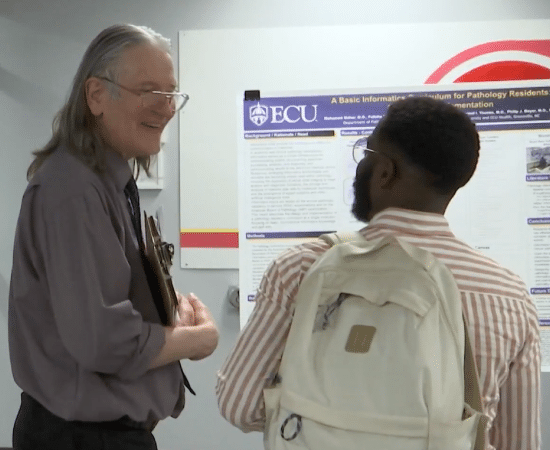
The ECU Brody School of Medicine held its 10th annual Medical Education Day. The event celebrates innovation in the medical field and offers an opportunity for leaders, educators, and students to promote changes in the industry.
The event was all about the discoveries being made in the medical field. It showed the growth of the medical community here in Eastern North Carolina with presentations and posters that allowed presenters to showcase their research.
Before the presentations started, ECU alumni Doctor Andrew Southerland gave a keynote speech about the impact of AI and Chat GPT in the medical field. After his speech, members of the event interacted with presenters about their projects, which were later judged in front of the crowd.
“Fills me with pride to see what our students are capable of doing. From start to finish the projects that then get adopted and adapted here and become a part of what is the Brody fabric,” said Dr. Jill Sutton, Obstetrics and Gynecology associate professor.
“This is really just an opportunity to share ideas and make sure we’re all together focused on how we can take the next step in medical education and I think that’s really what today all about and why I’m excited to be here,” said Brody School of Medicine student Ryan Dickerson.
Many of the topics mentioned at the event promoted education enhancement in certain fields including anatomy, and radiology, as well as tools that would help promote these subject matters.
Presenters in Thursday’s event featured not just students. Faculty and staff, as well as resident physicians, collaborated and looked forward to highlighting the curriculum and technologies used at the Brody School of Medicine in the future.

Over the years, students in the Brody School of Medicine at East Carolina University have personally witnessed the impact of cancer on countless lives.
Some have watched loved ones fight the disease, while others have worked with cancer patients during clinical rotations. Other students and alumni have even been cancer patients themselves.
Whatever their unique experiences with cancer have been, the response has been powerful. Their encounters with cancer turned into a growing tradition that benefits children from across eastern North Carolina who are fighting cancer battles of their own.
The eighth annual Pirates vs. Cancer event on April 12 raised close to $15,000 for pediatric cancer patients at ECU Health’s James and Connie Maynard Children’s Hospital.
Led by Brody students, the fundraiser has gained popularity and momentum over the years, with volunteers having their hair cut and donated, getting their heads shaved and even — for special faculty volunteers — receiving a pie to the face in support of the cause.
“One thing that I love about Pirates vs. Cancer is that you are able to see with your own eyes the direct impact of this work on the children at Maynard Children’s Hospital,” said Carly Uhlir, Brody student and event coordinator for Pirates vs. Cancer. “We know that every dollar we raise will add up to make a difference. Kids with pediatric cancer are more than just patients — they are among the strongest and bravest in our community. I want to continue the Pirates vs. Cancer mission that the founders so strongly believed in years ago and that has transcended all these years.”
Dr. Cedric Bright, senior associate dean of admissions for Brody, volunteered to receive pies in the face during the event on the lawn of the Health Sciences Student Center.
“It does your heart good to help the students with this type of thing to support those that are going through trying times with cancer,” he said. “Patients teach us so much, and this is just one way of us trying to give back to those patients that teach us so much.”
Jillian Berntsen of Kinston had her hair cut as an audience looked on and cheered — much like the health care teams and supporters helping her daughter during her cancer journey.
Berntsen said her daughter is receiving in-patient care at Maynard Children’s Hospital, her latest stay stretching for nine weeks. Pirates vs. Cancer gave the family a welcome respite from the hospital walls.
“There are so many things this hospital does, and the people we get to interact with have really become our family at this point from everything she’s been through,” Berntsen said. “We never really thought we’d have to experience anything like this and had no idea that things like this existed. This is the first time we’ve left the hospital in nine weeks, and knowing we had this to look forward to all week was something to get us through another week.”
The event was also eagerly anticipated by Brody students and community volunteers who wanted to help create a memorable and meaningful way to benefit pediatric patients. It has become part of a lifeline of support that keeps this special patient population equipped with resources to help them during their cancer journeys.
“The funds raised by PVC are critical to the maintenance of a positive environment for pediatric cancer patients here in Greenville,” said Grant Irons, Brody student and interdisciplinary chair of Pirates vs. Cancer.
Irons, who plans to pursue medical oncology as a specialty and spent time before medical school working with cancer patients, said the event also offers students a chance to see the realities of what some patients face and an opportunity to pause and look at the bigger picture.
“As future health care leaders, it is important to remember why we are here,” he said. “We entered the health care field to improve the lives of others. To become a well-rounded physician, I believe it is important to be involved outside of the classroom. There are endless opportunities to support our patient population here in Greenville, and I would encourage all health sciences students to lend a hand in these efforts.”
Dr. Cathleen Cook, Brody clinical associate professor of pediatric hematology/oncology and faculty advisor for Pirates vs. Cancer, said the event gives students exposure to the care of pediatric patients right here in eastern North Carolina.
“This fundraiser allows them the chance to see their financial contributions directly help these children while they are hospitalized in James and Connie Maynard Children’s Hospital and cared for in our ECU Pediatric Hematology/Oncology Clinic,” Cook said.
Previous donations through the event, she added, have been used to remodel an inpatient playroom, a space of respite for patients undergoing treatment. Pirates vs. Cancer also helps fund a portion of summer camps for pediatric hematology and oncology patients — Camp Rainbow and Camp Hope.
“Often, donors and volunteers are unaware of the administrative costs that are allocated from the proceeds and not able to see their donations at work,” Cook said. “For Pirates vs Cancer, 100% of the donations are re-invested in our pediatric patients, most specifically our oncology patients. It is my vision to continue to engage these future physicians annually and help support their goal of expanding this fundraiser.”
Brody student Katie Holt decided to get involved with the event to make an impact beyond fundraising. She served as this year’s president of Pirates vs. Cancer.
“Helping to put on this event is awe-inspiring because it puts into perspective the actual size of the Brody and health sciences community,” Holt said. “Applying to Brody, you are frequently told about the passion of the community in serving Greenville and eastern North Carolina. Helping to organize this event gives you a front-row seat to this passion in action.”
Holt said the annual event has caught on across the community.
“People I have never met have reached out to us to offer their help,” she said. “Businesses across the community donate their time and money. Employees from all different departments buy T-shirts to support us. Students across the many health sciences schools donate their hair. The event has shown us firsthand that ECU doesn’t just talk about serving others but goes above and beyond to invest in its community.”
Holt said the event, in addition to benefiting pediatric cancer patients, helps center medical students and remind them why they chose health care careers.
“Serving others, through this event or another community service program, benefits the community as well as serves to fight burnout and protect your mental health,” she said. “I know it has done this for me and many others on the Pirates vs. Cancer team by connecting us to something bigger than ourselves and keeping our sights fixed on a point beyond the next test.”
Uhlir said the event brings participants full circle in seeing their own life journeys while also understanding the magnitude of the battles other people face.
“It is both humbling and inspiring. As medical students, we often lose sight of the big picture. These patients have been through so much, so it is an amazing opportunity to be able to support them directly,” she said. “I also think back to all of the children I have known both personally and indirectly from the time I was a kid myself until now, and how this is such a great way of honoring their spirits.”
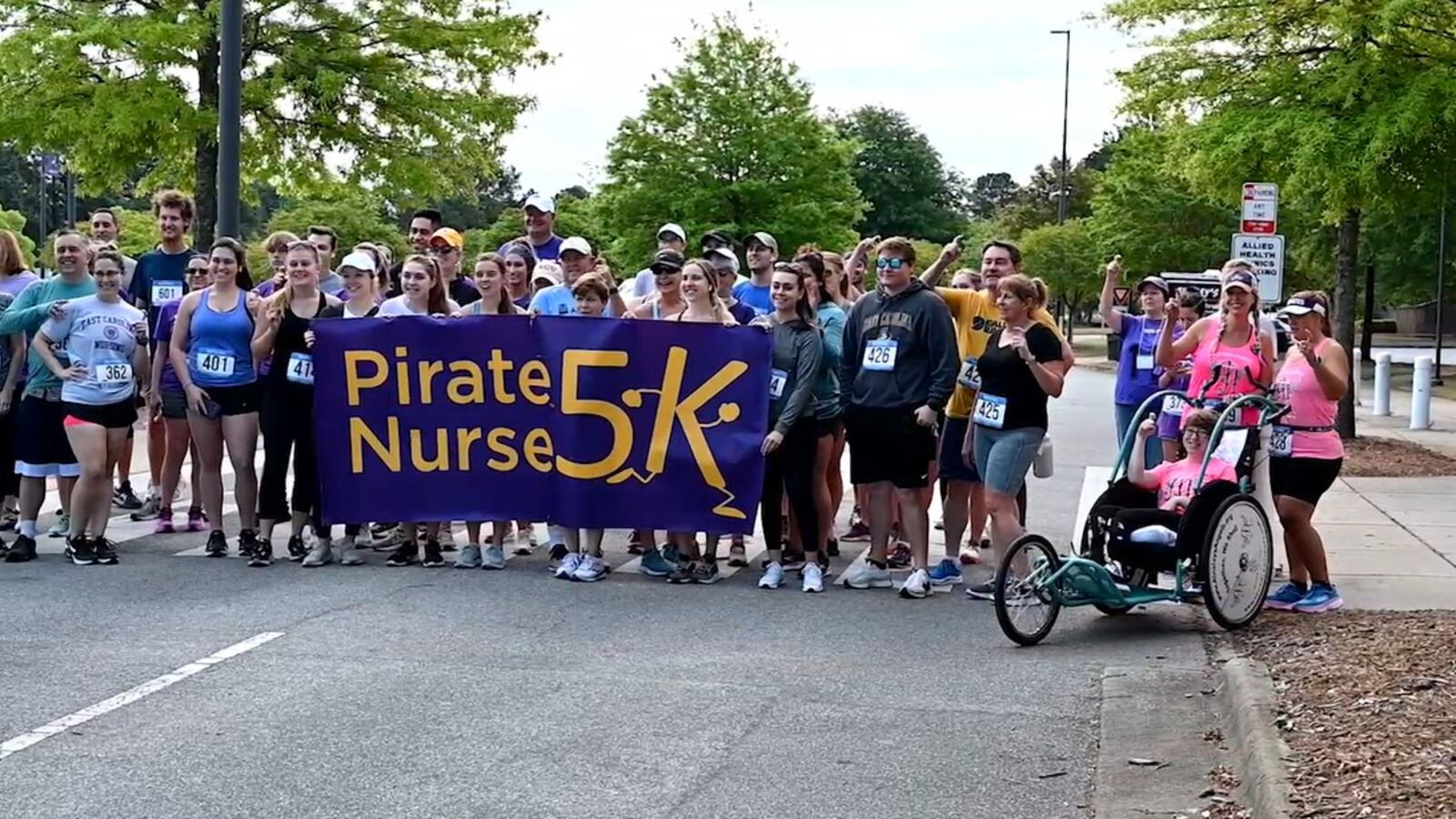
A 3.1-mile race hosted by East Carolina University College of Nursing is raising money for scholarships for nursing students.
The Pirate Nurse 5K is on April 13th. The ECU College of Nursing is looking to get as many participants as possible in hopes of giving nursing students every financial advantage for their education.
The university says proceeds benefit nursing student scholarships which will be awarded during the annual scholarship ceremony.
The race is a certified 5K course that participants can do both in-person and virtually, and awards for first and second place in age brackets for in-person and virtual participants will be presented.
The course paves a path through ECU’s Health Science Campus.
The registration fee up until April 6th will be $45. Students will pay $35, getting a $10 discount after registering online.
Those interested will be able to register on race day between 7:30 and 8:30 a.m. at the College of Nursing on ECU’s campus. A kids’ run will start at 9 a.m., and the 5K race will start at 9:15 a.m.
To register online, click here.
Alumni and friends answered the call to support East Carolina University during Pirate Nation Gives on March 20. Some even say it was the GOAT — the greatest of all time.
The eighth annual day of giving event surpassed expectations and raised more than $8.6 million in support of university priorities, including student scholarships, health care initiatives, athletics, and faculty and program support. In the first minute of the day, 64 donors made gifts, setting off donations from on campus and across the country as more than 2,800 Pirates gave during the 24-hour fundraiser.
“Thank you, Pirate Nation, for being part of an outstanding day of giving at ECU. We asked for you to make an impact on the university and you rose to the challenge,” Chancellor Philip Rogers said. “Your gifts and enthusiastic support of ECU allow the university to boldly pursue our mission. Because of you, ECU students will have more access to a top-tier education and more opportunities to participate in innovative initiatives and experiential learning programs. ECU will continue to transform and uplift the region we call home.”
Champions answered the call by establishing numerous challenges for donors, which, when fulfilled, unlocked additional gifts supporting scholarships and programs across all disciplines. Across the board, Pirate Nation showed its support for scholarships, student athletes, health care and initiatives throughout the university.
Notable gifts this year include:
- Chris Campbell, an industrial technology student, who honored his late mother by creating the Pamela A. Garriques Excellence in Logistics Scholarship Fund in the College of Engineering and Technology.
- Richard Cobb ’68, who established the Richard Cobb Sr. Freshmen Recruitment Scholarship Endowment in academic affairs and made a $25,000 gift to support the endowment.
- Max Joyner Sr., who made a $15,000 gift to support the Marching Pirates.
- David E. McCracken, who gave $15,000, and the Veteran Smiles Foundation, which made a $10,000 gift to support the ECU Veteran Patient Care Fund in the School of Dental Medicine. The combined gifts support the expansion of the Veteran Smiles program statewide.
- Oak Foundation’s $50,000 donation to the University Priority Fund for Greatest Needs, which helps the university to respond to immediate and pressing financial needs across ECU.
- Voyages of Discovery received broad support from donors, unlocking a $40,000 match for the community lecture series.
ECU donors could specify where and how they wanted their funds to be used, designating support to scholarships, research, innovative programs and more. Throughout the university new signs highlighted the influence of philanthropic efforts, allowing students, faculty and staff to see that many of the institution’s buildings, services, facilities and programs are made possible by donors.
Campus Spirit
Students, faculty and staff also participated in Pirate Nation Gives through a variety of on-campus initiatives aimed at building participation. A PeeDee squishmallow stuffed toy search and philanthropy honor cords for graduating Pirates added competitive spirit and boosted student involvement. Students accounted for 16% of the day’s donors. Hundreds visited tables at the campus student centers to share social media posts, snap up philanthropy cords, thank donors and support the cause.
Sophmore Christina Dowd was excited to capture a PeeDee squishmallow and earn $500 in bonus money for ECU’s STEPP program. Dowd said she was tracking the clues and found the PeeDee stuffed toy in a Main Campus Student Center meeting room.
STEPP Director Adam Denny said it is fantastic having students in the program participating in Pirate Nation Gives.
“It shows their interest in giving back to the program and, equally important, to the institution,” Denny said. “STEPP is one of the few academic support programs nationwide that provides access to resources to individuals with learning disabilities at no additional cost beyond tuition, which means every gift matters. For current students and the sustainability of our program, we are incredibly grateful for any support to our mission.”
Women’s basketball, club sports, disability support services, the School of Communication, the Office of Global Affairs, Integrated Coastal Studies Programs and the School of Theatre and Dance all earned bonus money from the PeeDee squishmallow search.
Fundraising Creativity
Across all of ECU’s colleges, schools and campuses, Pirate Nation Gives advocates found creative ways to boost interest in their funds.
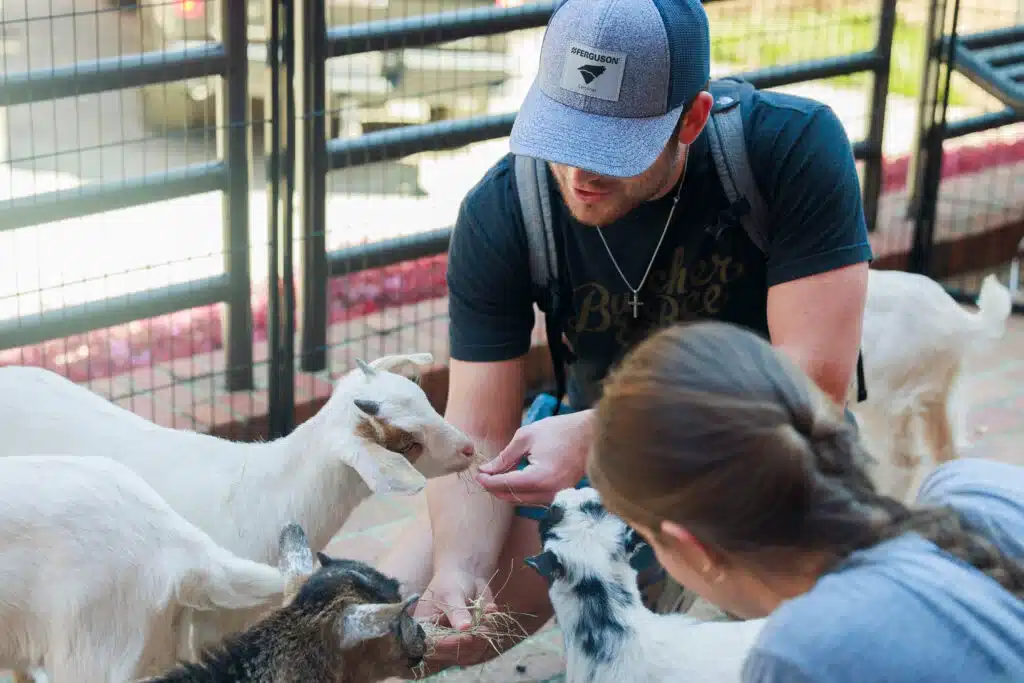
The Thomas D. Arthur Graduate School of Business wooed potential donors by bringing baby goats to campus. Students, faculty and staff who visited the Arthur School got to pet the pygmy goats.
Why goats? Dr. Linda Quick, assistant dean of the Arthur School, said it was because the Arthur School strives to be the GOAT when it comes to graduate education in eastern North Carolina.
“We asked all who stopped by to support the Arthur School by participating in Pirate Nation Gives. Doing so will ensure that we are well on our way to becoming the GOAT,” Quick said.
Funds raised by the Arthur School during Pirate Nation Gives will support student travel, scholarships, innovative programming for students, connections with industry leaders and additional opportunities for military affiliated students, among other initiatives.
Bonus leaders
Throughout Wednesday, leaderboards on the Pirate Nation Gives (PNG) website tracked support for areas of campus and encouraged giving with a competitive spirit. Numerous social media challenges gave participants the opportunity to win bonus money for their favorite ECU area or fund.
Serious competition began at midnight as donors vied to make the event’s first website gift. It was down to the millisecond to determine that two students, Nicole Barefoot and Anna Stone, tied in the timing of their gifts supporting the Club Sports Priority Fund – in honor of dance. They captured first place and $3,000 for the fund. Alumnus Eric Rivenbark captured second place and selected the ECU Alumni Association Priority Fund to earn $1,000 in bonus money.
Several club sports participants held watch parties to try and be the first to donate and win those bonus prizes. The effort to focus on the Club Sports Priority Fund grew from conversations within Campus Recreation & Wellness.“We started talking about PNG the first day I was hired in my current position. We were strategic on creating a united front and empowering our students and club sports to reconnect with alumni and build new relationships with donors, family and friends,” said Justin Waters, senior assistant director of sport programs. “Helping the students understand the ‘why’ helped the ‘how.’”
Waters said they had an “all for one, one for all” approach and had all 26 club sports come together to help raise scholarship dollars for the priority fund. The fund helps students offset costs they may accrue while playing a club sport at ECU. These dollars tear down barriers in order to help students keep chasing their passions, Waters said.
“Because of this day and all the philanthropy, we are able to provide financial relief for students during a time in our society where attending and staying enrolled in college is more costly than ever,” Waters said. “I also believe that it’s important that our students recognize that we are trying to be the best stewards of their interest and advocating for them during this day is a great way to build trust.”Night owls and watch parties paid off on the final gift competition of the day. The Recreation Sciences Alumni Society Fund captured first place and $3,000 thanks to a watchful eye on the clock from faculty member Edwin Gomez. Club Sports in honor of women’s volleyball was the runner-up fund with a gift from parent Emily Davis and will receive $1,000.For more information about the many ways to give to ECU, visit ECU University Advancement.

Trees at an Eastern Carolina hospital will be lit in different colors each month to raise awareness about the different forms of cancer.
“The spotlight on Cancer Project” kicks off Thursday night at ECU Health Beaufort Hospital in Washington – and the Shepard Cancer Center.
This month is Colon Cancer Awareness Month.
The lights on the hospital campus will be blue at night as a reminder about the importance of colonoscopies.